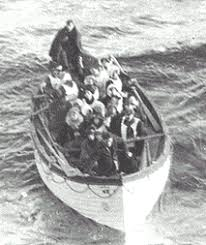
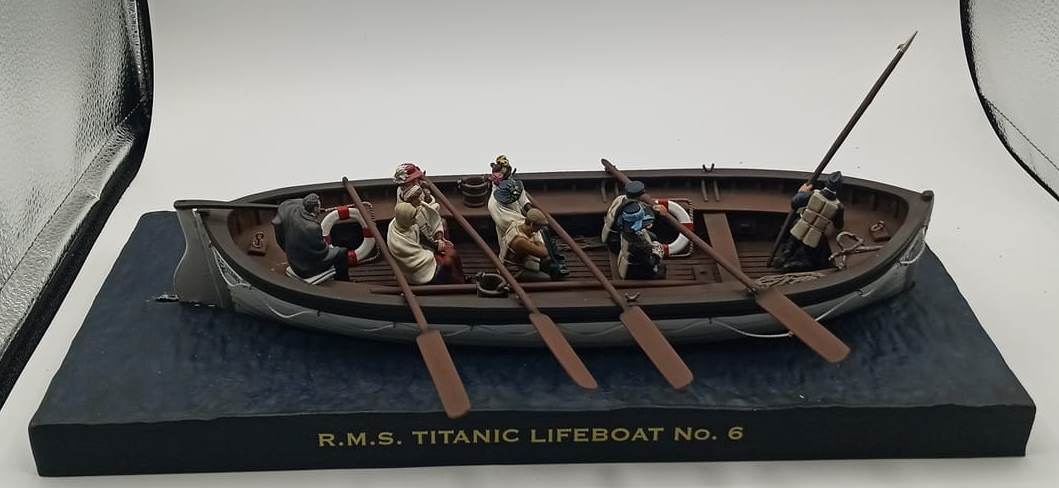
1100 Maquette canot de sauvetage #6 Le canot standard no 6 est mis à la mer à 1 h 10 avec à son bord entre 23 et 25 personnes pour 65 places. C'est le deuxième canot mis à la mer du côté bâbord, et le sixième en tout. À bord du canot, seuls des passagers de première classe ont été embarqués, ainsi que 4 membres d'équipages. Parmi les passagers de première classe, il y a 19 femmes, dont Margaret Brown, et un homme, le major Peuchen. Aucun homme n'a eu le droit de monter à bord de ce canot, mais au moment de la descente, une femme a réclamé plus de personnes pour manier les six rames du canot, et Arthur Peuchen a été autorisé à rejoindre le canot en se laissant glisser le long des cordes. L'officier Charles Lightoller, qui est chargé de remplir ce canot, nomme Robert Hichens responsable du canot. Il est celui qui tenait la barre du Titanic au moment ou celui-ci a heurté l'iceberg. À bord du canot, il tient la barre. Se trouve également dans le canot Frederick Fleet, la vigie qui a aperçu en premier l'iceberg. Selon certains, parmi lesquels Arthur Godfrey Peuchen, un jeune passager de troisième classe blessé serait monté à bord clandestinement. Selon d'autres, comme Margaret Brown, il a été invité à monter à bord par le capitaine. Il s'agirait de Philip Zenni, un Italien âgé de 25 ans. Alors que le canot s'éloigne du navire, plusieurs coups de sifflet retentissent, demandant au canot de venir charger d'autres passagers. Mais le canot ne revient pas, et selon Peuchen, c'est Robert Hichens, le responsable du canot, qui refuse. Après que le Titanic a coulé, une discussion éclate à propos de la nécessité de revenir sur les lieux du naufrage. Plusieurs passagers, parmi lesquels Margaret Brown et Helen Candee, ont demandé plusieurs fois à Hichens de revenir en arrière. Ce refus est confirmé par de nombreux témoignages des occupants du canot. Robert Hichens a déclaré devant une commission sur le naufrage ne pas se souvenir qu'on lui ait demandé de retourner en arrière, et se justifie également de ne pas être revenu par peur d'être aspiré par les remous. Durant la nuit, le canot est arrimé pendant un moment au canot no 16 et un chauffeur monte à bord pour aider à ramer, les femmes ayant ramé durant une grande partie de la nuit. Le canot rejoint le Carpathia vers 8 heures, et est ramené à New York. Fabricant: W. Britain
|
- > The Bank Line
- > Boutique / Shop
- > Voyage Irlande 2022
- > R.M.S. Ceramic
- > R.M.S. Arabic
- > R.M.S. Ionic
- > S.S. Regina
- > Scindia Steamships Co.
- > S.S. Canopic
- > Shaw Savill Line
- > Princess Cruises
- > MSC Cruises
- > MSC Cruises
- > S.S. Traffic
- > M.S. Queen Victoria
- > Orient Line
- > Ellerman Lines
- > Royal Caribbean
- > The Bank Line
- > Nouvelle page
- > S.S. Vedic
- > Carnival
- > Nouvelle page
- > Currie Line Ltd.
- > Royal Mail Lines
- > Harrison Line
- > S.S. Republic
- > R.M.S. Saxonia
- > S.S. Medic
- > R.M.S. Cedric
- > R.M.S. Teutonic
- > Wilson Line
- > R.M.S. Parthia
- > Royal Navy
- > Avant / après
- > R.M.S. Homeric
- > RMS Corinthic
- > R.M.S. Majestic
- > S.S. Oceanic
- > R.M.S. Mauretania II
- > R.M.S. Laurentic
- > R.M.S. Belgic
- > S.S. Runic
- > S.S. Baltic
- > Canadian National Steamship Co.
- > S.S. Carpathia
- > Liens
- > Canada steamship lines
- > R.M.S. Antonia
- > R.M.S. Britannic
- > Voyage Halifax 2015
- > Association québécoise du Titanic
- > Rencontre avril 2017
- > Rencontre octobre 2017
- > Rencontre avril 2018
- > Visite au cimetière Mont-Royal 3 mai 2015
- > Congres 2 mai 2015 St-Jérôme
- > Salon des collectionneurs 2013
- > Rencontre décembre 2015
- > Rencontre avec Élisabeth Navratil
- > MV Georgic
- > Film Titanic 1997
- > Blue Star Line
- > Film Titanic 1997
- > Nomadic
- > Centenaire 1912 / 2012
- > Mercredi 18 avril 2012
- > Mardi 17 avril 2012
- > Lundi 16 avril 2012
- > Dimanche 15 avril 2012
- > Samedi 14 avril 2012
- > Vendredi 13 avril 2012
- > Jeudi 12 avril 2012
- > Mercredi 11 avril 2012
- > L'Azamara Journey
- > Avant le départ
- > Direction New-York
- > Luxor Las Vegas
- > Visite Halifax 2015
- > Musée d'Orlando
- > MV Britannic
- > R.M.S. Titanic
- > 22 septembre 2015
- > 23 septembre 2015
- > 24 septembre 2015
- > 25 septembre 2015
- > 26 septembre 2015
- > Voyage Irlande 2015
- > 19 septembre 2015
- > 20 septembre 2015
- > 21 septembre 2015
- > Harland & Wolff
- > Figurine Ned Parfett
- > Pièces de collection
- > Poster ¨Tribute to Titanic's Lost Postal Workers
- > Document de cartographie et de planification et orientation
- > Autres pièces de collection
- > Carte postale In Memoriam
- > Morceau du Arrol Gantry
- > Oeuvre de Ivan Fraser
- > Bruno Wurtz
- > William Brabant
- > Autographe d'Élisabeth Navratil
- > Autographe d'Édith Haisman
- > Autographe Edith Haisman
- > Autographe de Louise Kink Pope
- > Collection Postes Canada
- > Vaisselle (reproductions)
- > Carte postale Milvilla Dean
- > Autographe d'Eva Hart
- > Plat baguette
- > Ensemble carafe et 6 verres
- > Titanic Clock
- > Verre en styromousse
- > Peintures sur des plumes par Cynthia A. Henry
- > Photo du Carpathia
- > Nouvelle page
- > Harland & Wolff Timing board
- > Figurine Edward John Smith
- > Veston Dik Barton
- > Canot #6
- > R.M.S. Titanic - Artéfacts
- > Tuile du smoking room
- > St-Louis Post-dispatch
- > Morceau de bois II
- > Broche Millvina Dean
- > Chèque Thomas James Everett
- > Nouvelle page
- > Morceau du big piece
- > Morceau de bois du Titanic
- > Morceau de charbon du titanic
- > Daily Graphic 20 avril 2012
- > Exposition Titanic in photographs Long Beach 2018
- > Voyage février 2018
- > Souvenirs Queen Mary
- > Photos autres bateaux
- > Photos Queen Mary part III
- > Photos Queen Mary part II
- > Photos Queen Mary part I
- > Photo chambre des machines
- > Bibliothèque
- > Rencontre France - Québec août 2017
- > Autres souvenirs
- > Artéfacts R.M.S. Olympic
- > Artéfacts White Star Line
- > Exposition Taschereau 2017
- > Hôtel
- > Pump House
- > Voyage Belfast septembre 2017
- > A.Q.T.
- > Tuiles
- > Souper avec John White 12 septembre 2017
- > Slipway
- > Samson & Goliath
- > Samson & Goliath
- > S.S. Nomadic
- > Musée du Titanic
- > Hôtel de ville de Belfast
- > Dry dock
- > Drawing office #2
- > Drawing office #1
- > Consultation room
- > Chorale jour de l'ouverture 10 septembre 2017
- > Bureau Thomas Andrews
- > Avions / aéroports
- > Belfast
- > R.M.S. Adriatic
- > Autres éléments de ma collection
- > Conférence dans les écoles
- > R.M.S. Queen Mary II
- > R.M.S. Alaunia
- > Cunard Countess
- > R.M.S. Olympic
- > S.S. Albertic
- > United States Lines
- > NKoninklijke Rotterdamsche Lloyd
- > Lamport & Holt Line
- > R.M.S. Saxonia
- > R.M.S. Carinthia I
- > R.M.S. Franconia
- > R.M.S. Ausonia
- > R.M.S. Aurania
- > R.M.S. Andania
- > S.S. Media
- > Nelson Steam Navigation Co.
- > Pacific Steam Navigation Co.
- > Red Star Line
- > R.M.S. Celtic
- > Anchor Donaldson Line
- > Swedish American Line
- > R.M.S. Scythia
- > Blue Funnel Line
- > British India Steam Navigation Co.
- > R.M.S. Carinthia
- > R.M.S. Lusitania
- > Riviera Cruises
- > American President Lines
- > Home Lines
- > States Marine Lines
- > Matson Navigation Co.
- > P & O Orient Lines
- > Italian Navigation Co.
- > Eastern Steamship Lines
- > Compagnie de navigation Sud-Atlantique
- > Koln-Dusseldorfer
- > R.M.S. Sylvania
- > Cunard
- > R.M.S. Caronia II
- > S.S. Megantic
- > Royal Viking Line
- > R.M.S. Mauretania
- > R.M.S. Samaria
- > Queen Mary I
- > Compagnie Générale Transatlantique
- > Moore-McCormack Lines
- > Cunard Princess
- > S.S. Doric
- > Norwegian Cruise Line
- > Alcoa Steamship Company
- > Norwegian Cruise Line
- > R.M.S. Berengaria
- > R.M.S. Carmania
- > R.M.S. Ivernia II
- > R.M.S. Caronia I
- > Son histoire
- > Autre articles de ma collection
- > Visite du musée
- > Visite sur le site du naufrage
- > Commémorations du 29 mai 2014
- > Exposition Histoire d'eau
- > Livres et documents
- > Artéfacts de ma collection
- > Commémorations du centenaire
- > Collection Postes Canada
- > American Export Isbrandtsen Lines
- > Grace Line
- > Allan Line
- > Canadian Pacific Steamships
- > Norddeutscher Lloyd
- > Hambourg America Line
- > Queen Elisabeth I
- > Holland America Line
- > Queen Elisabeth II
- > Norwegian American Line
- > Nouvelle page
- > R.M.S. Aquitania
- > Royal Mail Steam Packet Co.
- > Elders & Fyffes
- > Union Castle Mail Liner
- > Furness Bermuda Line
- > La collection
- > Expositions
- > Articles
- > Contributions
- > Liens
- > Contact
© 2017. Ma société. Tous droits réservés